EMA Ribbon vs SMA Ribbon for Binary Options: Which Works Better on Binany?
When it comes to EMA ribbon vs SMA ribbon binary options trading on Binany, the verdict is clear: EMA ribbon is the better choice for 1-minute and 5-minute charts
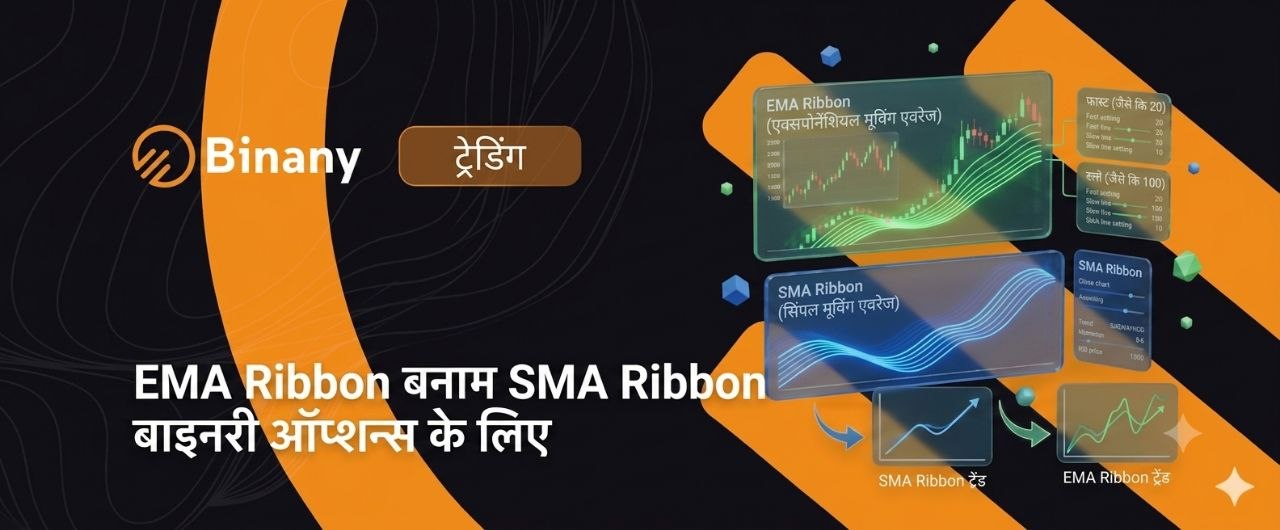
When it comes to EMA ribbon vs SMA ribbon binary options trading on Binany, the verdict is clear: EMA ribbon is the better choice for 1-minute and 5-minute charts. It signals trend changes faster, which matters when your expiry window is measured in minutes, not hours. The SMA ribbon has a legitimate role — but only on 15-minute charts and above, where its slower response becomes a strength rather than a weakness.
This guide breaks down exactly how EMA and SMA calculate differently, what that means for your signals on Binany, the recommended settings for each ribbon type, a side-by-side comparison table, and a clear decision guide so you know which ribbon to use for your timeframe and strategy.
How EMA and SMA Calculate Differently
The calculation method is what separates these two ribbon types — and understanding it explains every difference in how they behave on your chart.
Simple Moving Average (SMA)
SMA calculates the average price over a set number of bars, giving equal weight to every bar in the period. A 20-period SMA adds up the last 20 closing prices and divides by 20. The closing price from 20 bars ago has exactly the same impact on the result as the most recent bar.
This equal weighting makes the SMA ribbon smooth and resistant to short-term price spikes. That’s the advantage — and the limitation. When a genuine trend shift occurs, the SMA ribbon is slow to register it. Every old bar still carries full weight and pulls the average away from current price action.
Exponential Moving Average (EMA)
EMA gives more weight to recent prices using an exponential multiplier. The most recent bar has the strongest influence on the result; bars further back have progressively less. A 20-period EMA reacts noticeably faster to the last 3–5 bars than a 20-period SMA tracking the same period.
This is why the EMA ribbon tracks price more closely — it signals trend changes sooner and picks up pullbacks at tighter price levels. The trade-off is that it also reacts to short-term noise that a SMA ribbon would simply ignore.
The core difference: SMA is slower and smoother; EMA is faster and more reactive. In a ribbon of multiple lines, this difference compounds. An EMA ribbon vs SMA ribbon binary options comparison always comes down to timing — EMA ribbon signals faster but whipsaws more; SMA ribbon signals later but with fewer false alarms.
EMA Ribbon vs SMA Ribbon: Full Comparison
This is the central reference table for the EMA ribbon vs SMA ribbon binary options decision. Use it to match your setup to the right ribbon type.
| Feature | EMA Ribbon | SMA Ribbon | Verdict for Binany |
| Reaction speed | Fast — responds within 3–5 bars | Slow — responds over the full lookback period | EMA wins for 1-min and 5-min charts |
| Signal timing | Earlier — crossovers and expansions appear sooner | Later — confirmed only after several bars | EMA wins for short expiry binary options |
| Noise in ranging markets | Higher — more crossovers and whipsaws | Lower — fewer false crossovers | SMA wins in choppy conditions |
| Trend confirmation | Good — quickly confirms new trends | Strong — slower confirmation is more reliable | SMA wins on 15-min+ charts |
| Pullback zone accuracy | Tighter — lines sit closer to price | Wider — lines sit further from recent price | EMA wins for pullback entry precision |
| Visual clarity | Lines move rapidly — can appear busy in fast markets | Lines move smoothly — easier to read at a glance | SMA wins for readability |
| Best timeframe | 1-min, 3-min, 5-min charts | 15-min, 1-hour charts | Choose by timeframe |
| Best market condition | Trending markets with ADX above 20 | Trending markets and slow-moving ranges | EMA needs a trending market; SMA is more tolerant |
| Recommended for beginners? | Yes — with a strict no-trade rule in choppy markets | Yes — on 15-min charts only | EMA on 5-min; SMA on 15-min |
[Image: EMA ribbon and SMA ribbon side-by-side on EUR/USD 5-minute chart on Binany — EMA lines responding faster to price, SMA lines lagging behind]
The EMA vs SMA accuracy binary options comparison shows a clear split: EMA ribbon wins on speed and entry timing; SMA ribbon wins on smoothness and reliability at slower timeframes. Neither is universally better — they’re better at different things.
When to Use an EMA Ribbon on Binany
The EMA ribbon binary options case is strongest on the 5-minute chart. Here’s why — and where the limits are.
EMA Ribbon Strengths
Speed is the defining advantage of the EMA ribbon. On a 5-minute chart, price can move 5–10 candles before an SMA ribbon registers the shift. An EMA ribbon picks up the same move in 2–3 candles. For binary options with 15–25 minute expiry windows, entering 2–3 candles earlier means a better price and more time for the trade to develop in your direction.
The EMA ribbon’s tight tracking of price also makes pullback entries more precise. EMA ribbon pullback strategy binary options traders use relies on this: the ribbon sits closer to the current price, giving a clearer visual reference for where pullbacks are likely to stall. EMA ribbon trend following binary options setups benefit from this same quality — the expanding ribbon gives an immediate visual cue that a trend is accelerating.
Recommended EMA Ribbon Settings on Binany
[Image: Binany indicator panel showing EMA Moving Average being added with period 5 — first step in setting up a three-EMA ribbon]
| Setup | EMAs used | Timeframe |
| Minimal (beginner) | EMA 5 + EMA 20 | 1-min, 5-min |
| Standard | EMA 5, 10, 20, 50 | 5-min |
| Fibonacci-based | EMA 8, 21, 34 | 5-min, 15-min |
| Active 5-min setup | EMA 5, 10, 20 | 5-min |
The EMA 5 10 20 50 ribbon Binany standard setup is the correct starting point for most traders. Add each EMA separately via the Indicators panel on Binany, choosing a different colour for each period. The EMA ribbon settings Binany beginners should start with are EMA 5, EMA 20, and EMA 50 — three lines are readable without clutter.
EMA Ribbon Limitations
In choppy, sideways markets, the EMA ribbon becomes a liability. EMA lines cross each other repeatedly — producing the tangled ribbon state that looks like a nest of lines moving in every direction. Every crossover appears to be a new signal, but most reverse within a candle or two. This is the EMA ribbon choppy market binary options problem, and no setting adjustment fixes it.
The solution is simple: check ADX before every entry. ADX below 20 means a ranging market — skip all EMA ribbon signals until ADX rises above 20 and the ribbon begins expanding again. EMA ribbon false signals binary options traders generate almost all come from ignoring this rule.
When to Use an SMA Ribbon on Binany
The SMA ribbon binary options case is strongest on 15-minute charts and when you need a background trend filter rather than entry timing.
SMA Ribbon Strengths
The SMA ribbon’s main advantage is resistance to noise. Short price spikes and minor fluctuations have minimal effect on SMA lines — the ribbon only moves meaningfully when price has genuinely shifted direction over multiple bars. SMA ribbon smoother signals binary options traders get from this setup are better suited to longer confirmation windows.
On 15-minute charts, SMA ribbon smoother trend binary options performance is clear: the ribbon produces clean, readable signals with significantly fewer false crossovers than an EMA ribbon at the same settings. SMA ribbon fewer false signals binary options traders observe at this timeframe comes directly from the equal-weighting calculation. For traders who prefer fewer entries with higher confidence, the SMA ribbon on 15-minute charts is the right choice.
Recommended SMA Ribbon Settings on Binany
| Setup | SMAs used | Timeframe |
| Standard SMA ribbon | SMA 10, 20, 50 | 15-min, 1-hour |
| Extended SMA ribbon | SMA 10, 20, 50, 100 | 15-min |
| Trend context only | SMA 20, 50, 100, 200 | 1-hour and above |
SMA ribbon settings binary options traders find most useful on Binany’s 15-minute chart are SMA 10, 20, 50. The SMA 10 20 50 100 ribbon binary options extended setup adds detail but works best for trend context rather than active entry signals. SMA ribbon trend confirmation binary options use cases are where this setup genuinely earns its place.
SMA Ribbon Limitations
On 5-minute charts, the SMA ribbon’s slow response is a real problem. SMA ribbon lagging binary options traders experience on short timeframes means entry signals arrive 4–8 candles after a trend begins. At that point, much of the move available within a 15–25 minute expiry has already passed.
This is the SMA ribbon slow response binary options limitation that makes it unsuitable for 5-minute entries. SMA ribbon ranging market binary options conditions are also a concern: even though SMA ribbons produce fewer false signals than EMA ribbons in ranging markets, they still tangle and produce ambiguous signals when price has no clear direction.
Can You Combine EMA and SMA Ribbons?
Yes — and for intermediate traders, this dual-ribbon approach produces some of the cleanest setups available.
The Dual-Ribbon Setup
Some advanced traders use a combination: a fast EMA ribbon (EMA 5, 10, 20) for entry timing, and a slow SMA ribbon (SMA 50, 100, 200) as a background trend filter. The SMA ribbon acts as a fixed reference that defines the major trend direction. The EMA ribbon generates the actual entry signals within that trend.
The EMA SMA ribbon combination binary options rule is straightforward: only take EMA ribbon pullback entries in the direction confirmed by the SMA ribbon. If the SMA ribbon slopes upward and the lines are fanned out in order, only take Call entries from EMA ribbon pullbacks to the ribbon. Ignore all Put signals until the SMA ribbon changes direction. This is one of the cleaner best moving average ribbon type binary options setups for traders who have moved past the basics.
Is This Setup Suitable for Beginners?
No. Managing two ribbon types simultaneously adds significant visual complexity. When you’re still learning to read a single EMA ribbon expansion and contraction, adding a separate SMA ribbon creates noise that beginners consistently misread.
Master the single EMA ribbon setup — EMA 5, 10, 20, 50 — for at least 3 months of consistent trading before considering any dual-ribbon configuration. Add SMA 50 and SMA 100 as background lines only after you can read the EMA ribbon signals automatically without having to think through each step.
Decision Guide: Which Ribbon Is Right for You?
This table delivers the verdict by use case. No ambiguity — pick your situation and use the recommended ribbon.
| Your situation | Use this | Why |
| Trading 5-minute chart on Binany | EMA ribbon (5, 10, 20, 50) | Faster signals match short expiry windows |
| Trading 1-minute chart / scalping | EMA ribbon (5, 10, 20) | Maximum speed needed; accept higher false signal rate |
| Trading 15-minute chart | EMA or SMA ribbon (10, 20, 50) | Either works; SMA preferred for cleaner signals |
| Using ribbon for trend context only | SMA ribbon (50, 100, 200) | Not for entry timing — for background trend reference |
| Beginner on Binany | EMA ribbon (5, 20, 50) on 5-min chart | Simple, readable, correctly sized for the platform |
| Want fewer but higher-quality signals | SMA ribbon (20, 50, 100) on 15-min | Accept fewer entries for higher conviction |
| Building a dual-ribbon advanced setup | EMA ribbon (5, 10, 20) + SMA ribbon (50, 100) | EMA for entries; SMA for trend direction filter |
How to choose EMA or SMA ribbon Binany ultimately comes down to one question: what timeframe are you trading? If the answer is 5 minutes or below, EMA ribbon is the correct starting point. The best ribbon type short timeframe binary options traders should use is always the faster one — EMA. The best ribbon type long timeframe binary options setups call for SMA, where its smoothness is a feature rather than a delay.
The Single Most Important Rule
Whatever ribbon type you choose — EMA ribbon binary options or SMA ribbon binary options — never trade during a tangled, collapsing ribbon. When the lines cross and compress toward each other, the ribbon is communicating that no trend exists. Both EMA and SMA ribbons produce constant false signals in this state. The ribbon collapse rule overrides every other setup condition.
Conclusion
The EMA ribbon vs SMA ribbon binary options verdict on Binany: EMA ribbon for 5-minute and shorter charts. SMA ribbon for 15-minute and longer charts, or as a background trend filter. That’s the answer, and it holds across assets and strategies.
The core difference never changes: EMA is faster and more reactive — better entry timing, more false signals in choppy conditions. SMA is slower and smoother — fewer signals, better confirmation at longer timeframes. Neither performs well in a tangled ribbon state. Both require ADX above 20 to produce reliable entries.
The EMA ribbon Binany starting setup is EMA 5, EMA 20, and EMA 50 on the 5-minute chart. Add EMA 10 when you’re comfortable reading three lines. That’s where the best moving average ribbon type binary options setup for most Binany traders begins.
Open Binany demo, add EMA 5, EMA 20, and EMA 50 to a 5-minute EUR/USD chart, and watch how the ribbon expands and contracts during trending price action compared to a 15-minute chart with SMA 10, 20, 50. See the timing difference for yourself before committing to either type on a live account.
FAQ
Q1. What is the difference between an EMA ribbon and an SMA ribbon?
Both are sets of multiple moving averages plotted on the same chart, stacked in order of period length. The difference is in the calculation. EMA (Exponential Moving Average) gives more weight to recent prices, so it reacts faster to price changes. SMA (Simple Moving Average) gives equal weight to all bars in the period, making it smoother and slower. An EMA ribbon therefore signals trend changes earlier, but also reacts more to short-term noise. An SMA ribbon produces fewer but later signals with less noise. The EMA vs SMA moving average binary options choice comes down to whether you need speed or smoothness for your timeframe.
Q2. Which ribbon type is better for binary options on Binany?
For most Binany traders using 5-minute charts, EMA ribbon is the better choice. Binary options have fixed expiry windows, so getting the entry signal sooner directly improves trade timing. An EMA ribbon on EMA 5, 10, 20, 50 produces entries 2–4 candles earlier than an equivalent SMA ribbon on the same settings. For 15-minute charts, or when using the ribbon purely as a background trend filter, SMA ribbon is more appropriate. The EMA ribbon Binany setup is the right default for active traders. The answer to which MA ribbon is better binary options comes down to your chart timeframe.
Q3. Does EMA ribbon produce more false signals than SMA ribbon?
Yes — in choppy, sideways markets, an EMA ribbon will cross and tangle more frequently than an SMA ribbon at the same settings, producing more false signals. The EMA’s faster reaction to price means it responds to minor fluctuations that the SMA ribbon filters out. The solution is using ADX as a filter: only take EMA ribbon entries when ADX is above 20, confirming a trend exists. During ribbon tangle or when ADX is below 20, skip all EMA ribbon signals entirely. EMA ribbon false signals binary options traders experience almost always come from trading during ranging conditions, not from the settings themselves.
Q4. What EMA settings should I use for a ribbon on Binany?
The recommended starting setup for the 5-minute chart is EMA 5, EMA 20, and EMA 50. This three-line ribbon gives a readable visual without clutter. For a standard four-line ribbon, add EMA 10 between EMA 5 and EMA 20. A Fibonacci-based alternative is EMA 8, EMA 21, EMA 34 — this is popular for trend-following on 5-minute and 15-minute charts. To add each line on Binany: click Indicators, select Moving Average, choose EMA type, enter the period, and assign a different colour. Repeat for each EMA. The EMA ribbon settings Binany beginners should start with are EMA 5, 20, 50 — test on demo before going live.
Q5. When should I use an SMA ribbon instead of an EMA ribbon?
Use SMA ribbon when you are trading 15-minute charts or longer, or when you want a background trend filter rather than entry signals. On 15-minute charts, SMA 10, 20, 50 produces clean, reliable trend confirmation with fewer false crossovers. SMA ribbon is also useful as a background layer in a dual-ribbon setup: SMA 50, 100, 200 defines the major trend direction while a separate EMA ribbon generates the actual entries. Do not use SMA ribbon for 5-minute chart entries — the SMA ribbon 15 minute chart binary options use case is clear, but the 5-minute chart requires the faster EMA calculation to keep signals aligned with short expiry windows.
Q6. Can I use both EMA and SMA ribbons at the same time on Binany?
Yes — a dual-ribbon setup uses a fast EMA ribbon (EMA 5, 10, 20) for entry timing and a slow SMA ribbon (SMA 50, 100) for trend direction context. Only take EMA ribbon pullback entries in the direction confirmed by the SMA ribbon slope. If the SMA ribbon is sloping upward, only take Call entries from EMA ribbon pullbacks. This EMA SMA ribbon combination binary options approach suits intermediate traders comfortable reading multiple moving average lines simultaneously. Beginners should master a single EMA ribbon setup first. The dual-ribbon adds visual complexity that typically leads to misread signals during the learning phase.
Q7. Does the ribbon type matter for OTC market trading on Binany?
For OTC market trading on Binany at weekends, the EMA ribbon (EMA 5, 10, 20, 50) on the 5-minute chart is the appropriate choice. OTC assets follow algorithm-generated price feeds that produce consistent, medium-speed movements. EMA ribbons detect these shifts faster than SMA ribbons, keeping entries within viable expiry windows. The same rules apply as during regular market hours: during OTC ribbon tangle, skip entries regardless of what individual candles suggest. ADX still applies as a filter even on OTC assets. The EMA ribbon OTC market Binany setup mirrors the standard 5-minute live market configuration.
Q8. Which ribbon type is better for gold trading on Binany?
For Gold (XAU/USD) on the 5-minute chart, EMA ribbon (5, 10, 20, 50) is the correct choice. Gold trends clearly during the European and US sessions, and EMA ribbons track these moves efficiently. The EMA ribbon vs SMA ribbon gold binary options comparison favours EMA for active session trading and SMA for 15-minute trend analysis. SMA ribbon (10, 20, 50) provides cleaner trend confirmation on 15-minute gold charts with less noise from gold’s occasional sharp intraday spikes. The EMA ribbon performs particularly well on gold pullback entries at the ribbon upper edge during confirmed uptrends with ADX above 25.

Financial writer and market analyst with a passion for simplifying complex trading concepts. He specializes in creating educational content that empowers readers to make informed investment decisions.