Pin Bar Strategy on Binany: A Complete Guide for Traders
The pin bar strategy is one of the most reliable price action signals available to binary options traders. A single pin bar candlestick can tell you exactly where the market rejected a price level — and give you a clean, low-risk entry point before the next directional move
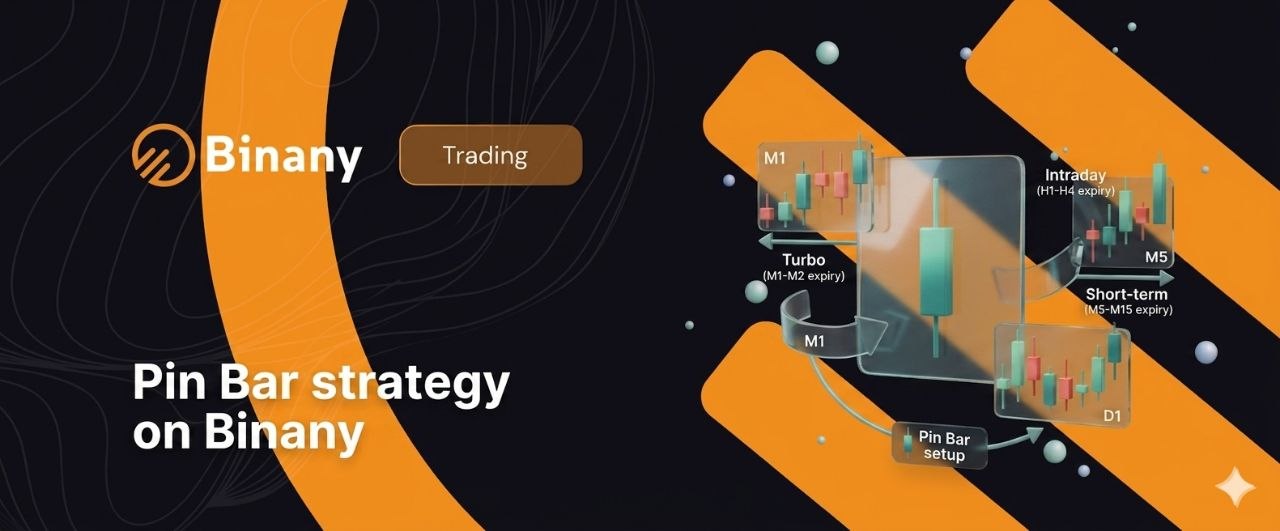
The pin bar strategy is one of the most reliable price action signals available to binary options traders. A single pin bar candlestick can tell you exactly where the market rejected a price level — and give you a clean, low-risk entry point before the next directional move. On Binany, where your entire trade outcome depends on predicting direction correctly, that kind of precision matters. This guide covers everything you need to start spotting, validating, and trading pin bars with confidence.
What Is a Pin Bar Candlestick?
A pin bar (short for Pinocchio bar) is a single candlestick with a long wick on one end, a very small body, and a short wick — called the nose — on the other end. The long wick shows that price moved sharply in one direction during the candle’s period, then was firmly rejected and snapped back. That rejection is the signal.
A bullish pin bar has its long wick pointing down. Sellers pushed the price lower during the candle, but buyers overwhelmed them and closed the candle near its high. This rejection candle signals that price is likely to move up from here.
A bearish pin bar is the opposite: long wick pointing up, small body near the bottom. Buyers attempted to push price higher, but sellers took control and closed the candle near its low. This wick candle signals that price is likely to reverse downward.
Pin bars are also related to well-known candlestick patterns. A bullish pin bar at support is essentially a hammer candlestick — the same structure, the same logic. A bearish pin bar at resistance mirrors the shooting star candle. Understanding the anatomy helps you spot valid signals faster.
| Part | Bullish Pin Bar | Bearish Pin Bar |
| Long Wick | Points downward — shows sellers pushed price down, buyers rejected it | Points upward — shows buyers pushed price up, sellers rejected it |
| Small Body | Forms near the top of the candle | Forms near the bottom of the candle |
| Nose | Small upper shadow (tip of the candle) | Small lower shadow (tip of the candle) |
| Signal | Reversal UP — enter Call | Reversal DOWN — enter Put |
| Also Called | Hammer / Dragonfly Doji | Shooting Star / Gravestone Doji |
Why Pin Bars Work on Binany
Pin bars work because they capture a real market event: a failed attempt to move price in one direction. That failure leaves a visible mark on the chart — the long wick — and gives you actionable information about where supply or demand stepped in.
This logic connects directly to how binary options work on Binany. When you place a Call or Put trade, you’re predicting whether price will be higher or lower at expiry. A pin bar at a key level gives you a high-probability directional bias based on where the market just rejected price — not guesswork, but structure.
Binany’s charting tools let you read pin bars clearly across multiple timeframes. You can set up candlestick charts, mark key support and resistance zones, and overlay indicators like the Exponential Moving Average (EMA) — all of which make pin bar binary options setups easier to find and validate.
Another reason pin bars suit binary options well is timing. A strong pin bar signal on M15 or M30 typically leads to a directional move that fits neatly within a standard binary options expiry window. You’re not guessing long-term direction — you’re reading a short-term rejection and acting on it quickly.
How to Identify a Pin Bar: Step-by-Step
Not every candle with a long wick qualifies as a tradeable pin bar. Here’s how to identify pin bar candles that are worth acting on:
- Check the wick-to-body ratio. The wick must be at least two to three times longer than the body. If the body is large relative to the wick, it’s not a pin bar — it’s a regular candle with some pressure. A proper pin bar looks visually obvious: a tiny body with a disproportionately long shadow on one end.
- Confirm the nose is small. The opposite end of the wick — the nose — should be short, ideally no more than one-quarter of the total candle length. A large nose signals indecision rather than rejection.
- Check the location. A pin bar reversal strategy only works when the candle appears at a meaningful price level: a defined support zone, a resistance level, a previous high or low, or a round psychological number. A pin bar floating in the middle of a trend with no nearby structure is far less reliable.
- Confirm trend context. A bullish pin bar is most powerful when it appears at support during a pullback within an uptrend. A bearish pin bar works best at resistance during a pullback within a downtrend. Pin bars against the prevailing trend require additional confluence to be worth trading.
Once you’ve checked all four criteria, you have a valid setup candidate. The more boxes it checks, the stronger the signal.
Best Timeframes and Expiry for Pin Bar on Binany
The timeframe you use determines the quality of your pin bar signal — and the appropriate expiry for your trade. Here’s how to match them:
| Chart Timeframe | Signal Quality | Recommended Expiry | Best For |
| M1 (1 min) | Low — too noisy | Not recommended | Scalpers only (avoid) |
| M5 (5 min) | Moderate | 5–10 minutes | Active short sessions |
| M15 (15 min) | Good | 15–30 minutes | Beginners ✓ |
| M30 (30 min) | High | 30–60 minutes | Intermediate traders ✓ |
| H1 (1 hour) | Very high | 1–2 hours | Swing-style setups |
The M1 chart (1-minute) generates too many low-quality signals. Every minor price fluctuation creates wick candles that look like pin bars but carry no meaningful rejection. This is the most common mistake for pin bar strategy beginners — trading M1 and being confused by constant false setups.
M15 is the recommended starting point for most traders on Binany. The signals are clear, the noise is manageable, and the 15–30 minute expiry window is realistic. Once you’re comfortable with M15, you can graduate to M30 for slightly more reliable — though less frequent — setups.
On M15, set your expiry to 15–30 minutes after entry. On M30, use 30–60 minutes. This gives the trade enough time to follow through on the reversal signal without overstaying a move that may exhaust itself.
Pin Bar + Support/Resistance: Confluence Trading
A pin bar on its own is a good signal. A pin bar at a confirmed support or resistance level is a significantly better one. This is what traders call confluence — multiple factors aligning in the same direction at the same time.
Here’s a practical example of a pin bar confluence trading setup. Price has been trending upward on M15. It pulls back to a clearly defined support level that previously caused two bounces. At that support zone, a bullish pin bar forms — long lower wick, small body near the top, tiny upper nose. At the same time, the 21-period EMA is sitting just below price and pointing upward.
That’s three factors confirming the same trade: the support level, the pin bar rejection candle, and the EMA as a dynamic filter. This pin bar with moving average strategy gives you a high-confidence entry for a Call trade with a 15–30 minute expiry.
Without confluence, you’re trading a pattern. With confluence, you’re trading a reason. The more factors that align — trend direction, key level, pin bar structure, EMA position — the higher your probability of a winning trade. Avoid entering pin bars that appear without at least one additional confirming factor.
Common Mistakes When Trading Pin Bars
Even traders who understand pin bar theory regularly make these errors:
- Trading every long wick as a pin bar. A valid pin bar has specific proportions: wick at least 2–3x the body, small nose, and a meaningful location on the chart. Candles that simply have a wick but no real rejection structure are not tradeable pin bar signals. This is the pin bar false breakout trap — acting on a setup that looks right but lacks the key criteria.
- Using the wrong timeframe. Trading pin bars on M1 produces a flood of false signals. Stick to M15 or higher until you have solid experience identifying valid formations.
- Ignoring trend direction. A bullish pin bar in a strong downtrend is fighting the dominant market structure. Unless there’s very strong confluence at a major level, counter-trend pin bars fail more often than they succeed.
- Skipping confluence. A pin bar in open space — no nearby support or resistance, no EMA alignment, no clear trend context — is a low-quality setup. Waiting for confluence is not hesitation; it’s discipline. The best pin bar setups are obvious and well-supported.
Practice the Pin Bar Strategy on Binany Demo
Before trading pin bars with real money, build your recognition skills on the Binany demo account. The demo environment uses live market data and the same interface as the live platform — the only difference is that your capital is virtual.
Spend at least one to two weeks on the demo exclusively focused on pin bar identification. Open the M15 chart, mark your key support and resistance levels, and wait for pin bars to form at those levels. Don’t rush entries — let the candle fully close before making a decision.
Track every demo trade in a log: the timeframe, the level, whether you had confluence, the expiry, and the result. After 20–30 trades, you’ll have real data on your setup selection. You’ll see which conditions produce the best outcomes and where your identification still needs work.
For a broader foundation in price action trading, see our guide on reading support and resistance levels on Binany. Once pin bars feel natural in the demo environment, you’re ready to apply the strategy with real capital.
Conclusion
The pin bar strategy gives you a simple, visual, and reliable way to read market rejection — and act on it before the next directional move. Three things separate successful pin bar traders from beginners: they only take setups at meaningful price levels, they wait for candle close before entering, and they always look for at least one additional factor to confirm the trade.
Learn to identify bullish and bearish pin bars on M15, combine them with support and resistance levels or the EMA, and manage your position size according to your risk rules. That combination gives you a repeatable edge on Binany without needing complex indicators or real-time news analysis.
Try the pin bar strategy on the Binany demo account before going live. Run it for two weeks, track your results, and refine your entry criteria. For a deeper understanding of the candlestick patterns related to pin bars, Investopedia’s guide to hammer and shooting star formations is a useful reference.
FAQ: Pin Bar Strategy on Binany
Q: What is a pin bar candlestick?
A pin bar is a single candlestick with a long wick on one end, a small body, and a short nose on the other end. The long wick shows that price was pushed strongly in one direction but rejected — snapping back before the candle closed. It’s one of the clearest price action signals for predicting short-term reversals.
Q: How do you trade a pin bar on Binany?
Follow these four steps:
- Open an M15 or M30 chart on Binany and mark your key support and resistance levels.
- Wait for a pin bar to fully close at one of those levels — long wick pointing away from the expected move direction.
- Confirm at least one additional factor: trend alignment, EMA position, or a second candle confirming direction.
- Enter a Call trade on a bullish pin bar or a Put trade on a bearish pin bar, with expiry set to 15–30 minutes for M15 or 30–60 minutes for M30.
Q: What is the best timeframe for pin bar strategy?
M15 (15-minute chart) is the recommended starting point for most traders. It provides clear signal quality with manageable noise, and pairs well with a 15–30 minute expiry window on Binany. M30 is slightly more reliable but generates fewer setups. Avoid M1 — the signal quality is too low for consistent pin bar identification.
Q: Is pin bar strategy good for binary options?
Yes — pin bars are well-suited to binary options because they give you a clear directional bias with a defined entry point. On Binany, where you simply need to predict whether price will be higher or lower at expiry, a strong pin bar at a key level gives you a high-probability direction to trade. The strategy works best when combined with support and resistance levels and confirmed by at least one additional technical factor.

Financial writer and market analyst with a passion for simplifying complex trading concepts. He specializes in creating educational content that empowers readers to make informed investment decisions.