MACD Divergence Strategy for Binary Options: Bullish and Bearish Guide for Binany
Standard MACD crossovers react to momentum shifts after they happen. MACD divergence catches them before — while price is still moving in the original direction
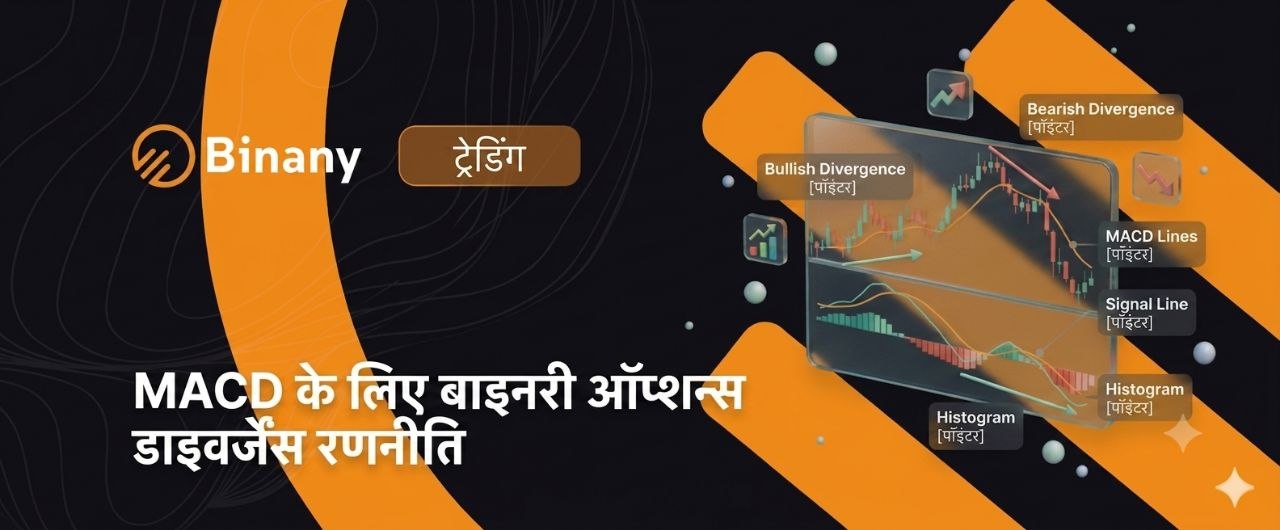
Standard MACD crossovers react to momentum shifts after they happen. MACD divergence catches them before — while price is still moving in the original direction. That’s the core advantage of the MACD divergence strategy: it shows you the engine losing power before the car actually stops.
MACD divergence occurs when price and the MACD indicator stop agreeing. Price makes a new extreme — a fresh low or a fresh high — but MACD fails to confirm it. That gap between price action and momentum is one of the earliest reversal warnings available on any binary options chart. Used correctly on Binany, this discrepancy gives you time to prepare an entry before the crowd catches on.
One thing must be said upfront: divergence is an early warning signal, not a trade trigger. Acting on divergence alone — without confirmation — results in frequent losses. The trend can continue for many candles after divergence forms. This guide covers regular bullish divergence, regular bearish divergence, hidden divergence for trend continuation, how to confirm each signal, how to time entries on Binany, and why divergence fails when it does.
What Is MACD Divergence and Why Does It Matter?
Understanding what drives divergence makes every other part of this strategy easier to apply.
The Core Concept
Divergence occurs when price action and the MACD indicator move in opposite directions — they diverge from each other. In a healthy uptrend, price and MACD should both make higher highs together. When price makes a new high but MACD does not, the divergence signals that buying momentum is weakening. The trend may be running out of fuel.
In a healthy downtrend, both should make lower lows together. When price makes a new low but MACD makes a higher low instead, selling pressure is fading beneath the surface. Think of it like an engine warning light: the car (price) is still moving forward, but the engine (momentum) is losing power. MACD divergence explained in one sentence: price is lying about strength that the indicator no longer confirms.
This is what makes MACD divergence binary options trading different from most other signals — it appears before the trend changes, not after.
Divergence vs Standard Crossover: Key Difference
| Aspect | MACD Divergence | Signal Line Crossover |
| Timing | Early — appears while old trend is still active | Late — confirms after direction has already shifted |
| Signal type | Warning of fading momentum | Confirmation of momentum shift |
| Action required | Wait for additional confirmation before entering | Still needs candle confirmation, but more direct |
| Best use | Catching tops and bottoms before they fully reverse | Entering pullbacks in established trends |
| False signal risk | Higher — divergence can persist without reversing | Moderate — high in ranging markets |
MACD divergence vs crossover binary options trading comes down to a timing trade-off. Divergence gets you in earlier but demands more patience and more confirmation layers. The crossover gets you in later but with a cleaner, more objective signal.
Two Types of Divergence
Regular divergence signals a potential trend reversal. Price reaches a new extreme but MACD does not — momentum is exhausting. Hidden divergence signals a potential trend continuation. Price makes a corrective move within the existing trend, but MACD diverges — momentum is recovering and the trend is likely to resume. Both types have bullish and bearish versions, giving four total setups to learn.
Bullish Divergence: Spotting Bottom Reversals
Bullish divergence is the most commonly traded divergence type. It identifies potential ends of downtrends and the start of bullish moves — Call option territory.
What Bullish Divergence Looks Like
Price makes a lower low — the downtrend appears to be continuing and a new swing low is printed on the chart. At the same time, MACD (either the MACD Line or the histogram) makes a higher low. Momentum has actually improved despite the lower price. Sellers are pushing price down, but with less conviction each time. Buying pressure is quietly building beneath the surface.
The MACD divergence lower low higher low pattern is the defining visual: two descending price points on the chart, two ascending MACD points in the indicator panel below. The strongest form of bullish MACD divergence binary options traders look for is when both the MACD Line AND the histogram make higher lows simultaneously while price makes a lower low. That double confirmation within MACD itself adds weight to the signal.
[Image: EUR/USD 5-minute chart on Binany showing bullish MACD divergence — price forms a lower low while the MACD histogram forms a higher low, followed by a hammer candle and a Call option entry.]
How to Identify Bullish Divergence Step by Step
- Confirm a downtrend exists — price is making lower highs and lower lows on the chart.
- Mark the two most recent swing lows on the price chart.
- Confirm the second low is lower than the first (lower low on price).
- Look at the MACD panel at those exact same two points in time.
- Check whether MACD shows a higher low at the second swing point — not a lower low.
- If price is lower but MACD is higher — bullish divergence is present.
Draw a line connecting both price swing lows, and a second line connecting both MACD points. The lines should slope in opposite directions. That visual contrast is your divergence.
Bullish Divergence Entry Rules (Call Option)
- Precondition: A clear downtrend must exist before the divergence forms. Divergence without a prior trend is noise, not signal.
- Divergence confirmed: Price lower low + MACD higher low, both on the same two swing points.
- Wait for: MACD Line beginning to rise AND a bullish candlestick pattern forming at the divergence low — hammer, bullish engulfing, or morning star.
- RSI check: RSI should be below 50 but starting to turn upward. RSI also showing bullish divergence at the same point is a strong bonus confirmation.
- Entry: MACD bullish divergence call option placed after the confirmation candle closes. Never enter while the candle is still forming.
- Expiry: 4–6 candles ahead on the entry timeframe. Divergence reversals need more time than standard crossovers.
Bearish Divergence: Spotting Top Reversals
Bearish divergence is the mirror image of bullish divergence. It identifies potential ends of uptrends and the start of bearish moves — Put option territory.
What Bearish Divergence Looks Like
Price makes a higher high — the uptrend appears to be continuing. A new swing high is printed on the chart. MACD (Line or histogram) makes a lower high at the same time — momentum is fading despite the higher price. Buyers are pushing price up, but with decreasing force. Selling pressure is building beneath the surface that the price chart isn’t yet showing.
The MACD divergence higher high lower high pattern is what you’re watching for: two ascending price points on the chart, two descending MACD points in the indicator panel. The strongest form of MACD bearish divergence binary options signal occurs when price makes a higher high AND both the MACD Line AND histogram make lower highs simultaneously.
[Image: Gold 5-minute chart on Binany showing bearish MACD divergence — price forms a higher high while MACD histogram forms a lower high, followed by a shooting star candle and a Put option entry.]
How to Identify Bearish Divergence Step by Step
- Confirm an uptrend exists — price is making higher highs and higher lows.
- Mark the two most recent swing highs on the price chart.
- Confirm the second high is higher than the first (higher high on price).
- Check the MACD panel at those same two swing high points.
- The MACD must show a lower high at the second swing point — not a higher high.
- Price higher + MACD lower = bearish divergence confirmed.
Bearish Divergence Entry Rules (Put Option)
- Precondition: A clear uptrend before the divergence forms.
- Divergence confirmed: Price higher high + MACD lower high, on the same two swing points.
- Wait for: MACD Line beginning to fall AND a bearish candlestick at the divergence high — shooting star, bearish engulfing, or evening star.
- RSI check: RSI should be above 50 but starting to turn downward. RSI also showing bearish divergence = strong bonus confirmation.
- Entry: MACD bearish divergence put option placed after the confirmation candle closes.
- Expiry: 4–6 candles ahead on the entry timeframe.
Hidden Divergence: Trading with the Trend
Hidden divergence is the opposite of regular divergence. Where regular divergence warns of a reversal, hidden divergence confirms the trend will continue. It’s the divergence type trend-following traders use to enter pullbacks at the right moment.
| Type | What price does | What MACD does | Signal |
| Regular bullish divergence | Makes a lower low | Makes a higher low | Reversal — end of downtrend → Call |
| Regular bearish divergence | Makes a higher high | Makes a lower high | Reversal — end of uptrend → Put |
| Hidden bullish divergence | Makes a higher low (pullback in uptrend) | Makes a lower low | Continuation — uptrend resumes → Call |
| Hidden bearish divergence | Makes a lower high (bounce in downtrend) | Makes a higher high | Continuation — downtrend resumes → Put |
Hidden Bullish Divergence (Pullback Entry in Uptrend)
Price is in a clear uptrend making higher highs and higher lows. During a pullback, price makes a higher low — the pullback stays above the previous low, which means the uptrend structure is intact. At the same time, MACD makes a lower low at the same pullback point — it looks more pessimistic than the price actually warrants.
The MACD bullish hidden divergence binary options signal tells you one thing: the pullback is shallow, buyers are still in control, and the uptrend is likely to resume. This is a high-probability continuation entry, not a reversal trade. Entry: Call option on the bullish confirmation candle that forms at the higher low. Expiry: 4–6 candles ahead.
Hidden Bearish Divergence (Bounce Entry in Downtrend)
Price is in a clear downtrend making lower lows and lower highs. During a bounce, price makes a lower high — the bounce fails to reach the previous high, confirming the downtrend structure is intact. MACD makes a higher high at that same bounce point — it looks more optimistic than the price actually shows.
The MACD bearish hidden divergence binary options signal means the bounce is weak and sellers remain in control. Entry: Put option on the bearish confirmation candle at the lower high. This is a trend-continuation setup, not a reversal trade. Regular divergence MACD binary options use cases differ from hidden divergence — know which type you’re trading before placing the option.
How to Confirm MACD Divergence Before Entering
Divergence identification is step one. Confirmation before entering is the step that determines whether the strategy is profitable.
Core rule: MACD divergence alone is never sufficient as an entry signal for binary options. Every divergence trade requires at least two of the three confirmation layers below.
Confirmation Layer 1: Candlestick Pattern
A reversal candlestick must form at the divergence extreme — at the lower low for bullish divergence or the higher high for bearish divergence. For bullish divergence: a hammer, bullish engulfing, or morning star. For bearish divergence: a shooting star, bearish engulfing, or evening star.
The MACD divergence with candlestick binary options rule is absolute: the confirmation candle must close before you place the option. A candlestick that looks perfect at 80% of its formation can still reverse and close as the opposite pattern. Candlestick pattern at MACD divergence must be complete — no exceptions.
Confirmation Layer 2: RSI Alignment
Add RSI (14) to the Binany chart alongside MACD. For bullish divergence: RSI should be below 50, showing neutral to oversold conditions, and beginning to turn upward. If RSI also shows bullish divergence at the same swing low — that is double confirmation and a very strong signal. For bearish divergence: RSI should be above 50 and beginning to turn downward. RSI confirming MACD divergence binary options setups dramatically improves reliability.
Avoid taking bullish divergence entries where RSI is already above 65. At that level, momentum may have recovered too fast and a second leg down remains possible. The MACD divergence with RSI binary options combination works best when RSI still has room to move in the expected direction.
Confirmation Layer 3: Key Level Confluence
MACD divergence at support resistance is significantly more reliable than divergence forming in empty chart space. The divergence extreme point — the low for bullish, the high for bearish — should align with a known technical level: a support or resistance zone, a Fibonacci retracement level (38.2%, 50%, or 61.8%), or a key moving average such as the 20 EMA.
Divergence that forms mid-range with no nearby technical level is substantially less reliable. MACD divergence confluence trading works on a simple scaling rule: one confirmation = moderate signal; two confirmations = strong signal; three confirmations (divergence + candle + level) = highest-probability MACD divergence entry. Multiple divergence confirmations binary options setups produce the best results.
Confirmation Reference Table
| Confirmation | Bullish divergence (Call) | Bearish divergence (Put) |
| Price action | Lower low confirmed | Higher high confirmed |
| MACD | Higher low on MACD Line or histogram | Lower high on MACD Line or histogram |
| Candlestick | Hammer / Bullish Engulfing / Morning Star at low | Shooting Star / Bearish Engulfing / Evening Star at high |
| RSI | Below 50, starting to rise; RSI divergence = bonus | Above 50, starting to fall; RSI divergence = bonus |
| Level | At support / Fibonacci / EMA | At resistance / Fibonacci / EMA |
| MACD Line direction | Beginning to rise after divergence | Beginning to fall after divergence |
Step-by-Step Divergence Trade on Binany
This is the complete MACD divergence entry rules binary options process — from chart setup to option placement.
Full Setup Process
- Open the Binany demo chart. Select EUR/USD or Gold. Set the timeframe to 5 minutes.
- Add MACD (12, 26, 9) and RSI (14) from the Indicators panel. Optionally add a 20 EMA for trend context.
- Confirm a clear trend is present — an uptrend for bearish divergence search, a downtrend for bullish divergence search.
- Watch for price to make a new extreme: a higher high in an uptrend or a lower low in a downtrend.
- Simultaneously check the MACD panel — does MACD confirm the new extreme, or does it make an opposing move?
- If MACD diverges: mark both swing points on price and both corresponding MACD points. Draw connecting lines to visualise the divergence clearly.
- Wait for a candlestick reversal pattern to close at the divergence extreme. Do not enter while the candle is forming.
- Confirm RSI alignment and check for a key technical level at the divergence point.
- After the confirmation candle closes: place Call (bullish divergence) or Put (bearish divergence). This is how to use MACD divergence on Binany correctly — the entry comes after the close, not before.
- Log in your trading journal: asset, divergence type, confirmations present, expiry, outcome.
Expiry Guidance
| Chart timeframe | Recommended expiry | Reasoning |
| 1-minute chart | 5–10 minutes | Divergence reversals need 5–10 bars to develop |
| 5-minute chart | 20–30 minutes | Standard — 4–6 candles ahead |
| 15-minute chart | 60–90 minutes | Larger divergences take longer to fully reverse |
MACD divergence expiry time binary options selection matters more than with standard crossover trades. After divergence forms, price sometimes makes one final push in the original direction before reversing — the longer expiry gives the reversal time to fully develop. On the MACD divergence 5 minute chart Binany setup, 20–30 minutes is the reliable standard.
Why MACD Divergence Fails and How to Manage the Risk
MACD divergence false signal binary options outcomes are common. Understanding why they happen is how you avoid the most expensive ones.
Reason 1: Strong Trends Override Divergence
In a very strong trend with sustained momentum, divergence can form and then be immediately negated as the trend accelerates. The trend simply has more energy than the divergence warning suggested. This is the most humbling failure mode — you identified the divergence correctly but the market didn’t care.
The rule: only trade divergence against trends already showing signs of exhaustion — smaller candle bodies at the extreme, increasing wicks, slowing momentum on a higher timeframe. Never trade bearish divergence against a fast-moving uptrend that has been running for fewer than 10 candles. Wait for the trend to mature before looking for divergence.
Reason 2: Entering Before Confirmation
The most costly divergence mistake is entering the moment divergence is identified — before any candlestick confirmation or level test. Divergence can persist for 5, 10, or even 20 candles while the trend continues. Entering early means absorbing multiple losses before the eventual reversal arrives.
The rule: never place an option on divergence alone. The reversal candlestick must close before the option is placed. This is the single most repeated rule in this guide because it is the single most broken rule in practice.
Reason 3: Measuring From Wrong Swing Points
Divergence requires comparing the correct structural swing highs or lows. Using arbitrary mid-trend points, comparing swings of mismatched size, or forcing a divergence reading where one doesn’t clearly exist produces false signals. If you have to squint to see the divergence, it’s not there.
The rule: use the two most recent clear, structural swing points — not price noise. The swings must be significant enough that a horizontal line can be drawn cleanly through them. If the second swing point is ambiguous, wait for a clearer setup.
MACD Divergence Pros and Cons
| # | Pros | Cons |
| 1 | Earliest available reversal signal — appears before the crossover | Divergence can persist for many candles without reversing |
| 2 | Works on any Binany asset and timeframe | Measuring correct swing points is subjective and error-prone |
| 3 | Hidden divergence provides high-quality trend continuation entries | Strong trends override divergence — false signal risk is real |
| 4 | Triple confirmation (divergence + candle + level) is one of the highest-probability setups in binary options | Requires more patience and analysis than standard crossover signals |
| 5 | Applicable to both the MACD Line and MACD histogram — two divergence sources in one indicator | Divergence alone — without confirmation — is unreliable as an entry trigger |
Conclusion
Four divergence types, four entry directions: regular bullish (Call), regular bearish (Put), hidden bullish (continuation Call), hidden bearish (continuation Put). The MACD divergence strategy covers both ends of the trend cycle — reversals and continuations — from a single indicator.
The most important rule in this entire guide: divergence is a warning, not a trade trigger. The confirmation candle must close before the option is placed. MACD divergence binary options entries made before confirmation close at a higher loss rate than any other execution error in this strategy.
The confluence rule holds throughout: MACD bullish divergence binary options and MACD bearish divergence binary options setups reach their highest probability only when divergence aligns with a candlestick reversal pattern AND a key technical level. That three-layer combination — divergence + candle + level — is the setup worth waiting for. Expiry at 4–6 candles gives the reversal time to develop after the entry.
Add MACD (12, 26, 9) and RSI (14) to EUR/USD on your Binany demo chart. Look for the next swing low where price goes lower but MACD goes higher — then wait for the hammer candle to close before placing your Call. That sequence is the full MACD divergence strategy applied in three steps.
FAQ
Q1. What is MACD divergence and how does it work in binary options?
MACD divergence occurs when price action and the MACD indicator move in opposite directions. In an uptrend, if price makes a higher high but MACD makes a lower high, that is bearish divergence — buying momentum is weakening and a reversal downward may follow. In a downtrend, if price makes a lower low but MACD makes a higher low, that is bullish divergence — selling momentum is fading. Divergence is an early warning that a trend may be losing energy. It appears before standard crossover signals and always requires additional confirmation before you act on it. Trading divergence alone, without a confirming candlestick and a key level, produces a high rate of losing trades.
Q2. What is the difference between bullish and bearish MACD divergence?
Bullish MACD divergence binary options signal forms at the end of a downtrend. Price makes a lower low while MACD makes a higher low — selling momentum is fading and a reversal upward may follow. You place a Call option after a bullish candlestick closes at the divergence low. Bearish MACD divergence binary options signal forms at the end of an uptrend. Price makes a higher high while MACD makes a lower high — buying momentum is weakening and a reversal downward may follow. You place a Put option after a bearish candlestick closes at the divergence high. Both require the confirmation candle to fully close before entry.
Q3. What is hidden divergence in MACD and how is it different from regular divergence?
Regular divergence signals a potential trend reversal. Hidden divergence signals a potential trend continuation. Bullish hidden divergence forms during an uptrend pullback: price makes a higher low while MACD makes a lower low. The pullback is shallow and the trend will likely resume upward — Call entry on the confirmation candle. Bearish hidden divergence forms during a downtrend bounce: price makes a lower high while MACD makes a higher high. The bounce is weak and the trend will likely continue downward — Put entry. MACD bullish hidden divergence binary options setups are particularly useful for trend-following traders who want to enter pullbacks at the right moment rather than chasing breakouts.
Q4. How do I confirm a MACD divergence signal before placing a binary option?
Never trade divergence alone. Require at least two of three confirmations before placing any option. First, a candlestick reversal pattern must close at the divergence point — hammer or bullish engulfing for Call entries; shooting star or bearish engulfing for Put entries. Second, RSI should align: below 50 and rising for bullish divergence, above 50 and falling for bearish divergence. Third, the divergence should form at a key technical level — support, resistance, a Fibonacci retracement, or a moving average. MACD divergence confirmation binary options entries with all three layers present represent the highest-probability setups available with this strategy.
Q5. How do I identify MACD divergence on the Binany chart?
Add MACD (12, 26, 9) to the Binany chart via the Indicators panel. For bullish divergence: find the two most recent swing lows on the price chart — the second must be lower than the first. Look at the MACD panel at those same two points — if MACD shows a higher low, bullish divergence is confirmed. For bearish divergence: find the two most recent swing highs — the second higher on price, lower on MACD. Draw a line through both price swings and both MACD points to visualise the divergence. If the lines slope in opposite directions, the divergence is real. If you have to force the reading, the setup isn’t there — skip it.
Q6. Can MACD divergence fail? What should I do when it does?
Yes — divergence fails regularly, especially in strong trending markets where momentum overrides the warning signal. The most common failure cause is entering before confirmation: acting on divergence alone without waiting for a candlestick close. The second most common cause is measuring divergence from incorrect or ambiguous swing points. When a MACD divergence false signal binary options trade loses, accept it as part of the strategy’s normal failure rate. Do not immediately re-enter. Review whether all three confirmations were present before entry. Only adjust your approach after reviewing 20 or more trades, not after a single loss.
Q7. What expiry time should I use for MACD divergence trades on Binany?
Divergence reversals take more time to develop than standard crossover signals. Use longer expiry times relative to your chart timeframe. For the 5-minute chart, use 20–30 minute expiry (4–6 candles ahead). For the 1-minute chart, use 5–10 minutes. For the 15-minute chart, use 60–90 minutes. After divergence forms, price sometimes makes one more push in the original direction before reversing — the longer expiry gives the reversal room to develop without expiring prematurely. Never use 1–3 minute expiry for MACD divergence expiry time binary options trades, regardless of timeframe.
Q8. Is MACD divergence better than a standard crossover signal?
Divergence gives earlier entries — it appears before the crossover occurs, allowing you to catch more of the reversal move. However, it requires more analysis, is more subjective in identifying correct swing points, and has a higher false signal rate than crossover signals. Standard crossovers are easier to identify objectively and produce cleaner signals. The MACD divergence vs crossover binary options comparison isn’t really an either-or question. The ideal approach uses both: watch for divergence as an early warning, then enter on the crossover or candlestick confirmation that follows. Divergence identifies the location; the crossover confirms the timing. Used together, they form a more complete MACD divergence strategy than either approach alone.

Financial writer and market analyst with a passion for simplifying complex trading concepts. He specializes in creating educational content that empowers readers to make informed investment decisions.