Naked POC Strategy for Binary Options: How to Trade Unvisited Volume Levels on Binany
Every unvisited Point of Control from a previous session is a debt the market owes to itself. Price left that level behind — but the participants who traded most heavily there didn't forget it
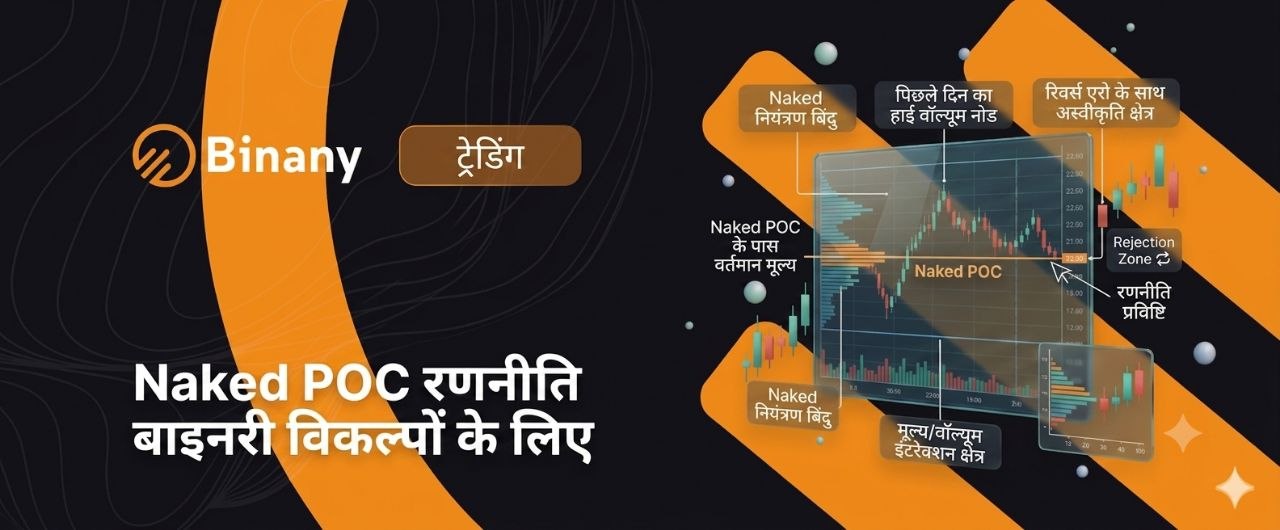
Every unvisited Point of Control from a previous session is a debt the market owes to itself. Price left that level behind — but the participants who traded most heavily there didn’t forget it. That unresolved business is what makes the Naked POC strategy one of the most objective, precisely defined setups in volume-based trading on Binany.
A Naked POC is a Point of Control from a past trading session that price has not returned to visit since the session closed. Because POC levels represent the price where maximum volume — maximum institutional consensus — was traded, the market has a strong statistical tendency to revisit them. Traders call this tendency the magnet effect. Unlike a vague support zone drawn by eye, a Naked POC is a single exact price level derived from real volume data. That precision is its core advantage for binary options.
This article is a focused deep-dive that builds on the Volume Profile Trading Strategy guide. It covers what makes a POC “naked,” why the magnet effect has a statistical basis, how to locate Naked POC levels on TradingView, the three distinct entry types, confirmation rules for each, and the specific conditions where the setup fails. Naked POCs are magnets — not certainties. A strong opposing trend can override the pull completely.
POC vs Naked POC: What Makes a Level ‘Naked’?
If you’ve already read the Volume Profile guide, you know that the POC is the price with the highest volume in a given session. What distinguishes a Naked POC from a regular POC is status — specifically, whether price has revisited the level since it formed.
| Feature | Regular POC | Naked POC |
| Definition | Point of highest volume in the current session — being actively formed | POC from a past session that price has not revisited since closing |
| Status | Active — price is currently in the vicinity | Orphaned — price has moved away and left it unvisited |
| Market significance | Represents current fair value | Represents a prior consensus that was abandoned — still exerts pull |
| Trading use | Intra-session support/resistance | Multi-session magnet target — price tends to fill it |
| Expiry on the chart | Disappears when revisited or replaced by current session | Remains visible and relevant until price finally touches the level |
Why a POC Becomes ‘Naked’
When a session ends and price closes far from the session’s POC, that level has been abandoned. Market participants who traded heavily at that price — institutional desks, algorithmic strategies, large-order operators — still have open interest and memory at that level. The session ended before the auction at that price was fully resolved.
As subsequent sessions begin, those participants and the algorithms tracking their activity create conditions that draw price back toward the unvisited POC binary options level. This is not a mystical phenomenon — it is a concrete consequence of how large-order participants behave around known high-volume prices. The point of control trading binary options setup exploits exactly this behavioral pattern.
The longer a Naked POC remains unvisited, the more sessions of accumulated interest build at that level — and in most cases, the stronger the eventual pull becomes.
Why the Magnet Effect Works: The Statistical Logic
Understanding the mechanism behind the POC magnet effect gives you the context to judge when to trust it and when to be skeptical.
The Mean Reversion Mechanism
Volume Profile operates on a mean-reversion principle. Markets spend the majority of their time seeking fair value — the price level where buyers and sellers reach equilibrium. The POC is the empirical definition of that equilibrium point for its session: the exact price where the most participants agreed to trade.
When price moves significantly away from the POC without returning, it has deviated from consensus fair value. The naked POC fill binary options setup is essentially the market completing an unfinished auction — returning to a price that generated maximum volume but was then abandoned before that auction cycle fully resolved. The POC fill strategy binary options approach treats this incomplete auction as a measurable, repeatable tendency.
Naked POC Fill Probability: Time and Distance
Not all Naked POCs carry equal weight. Recency and proximity to current price are the two key variables that determine how reliable the magnet effect is for active binary options trading.
| Time elapsed since POC formed | Distance from current price | Expected fill probability |
| Same day (1–4 hours) | Within 0.3% of current price | High — intraday mean reversion likely |
| Previous day | Within 0.5% of current price | Medium-high — next session likely to revisit |
| 2–3 sessions ago | Within 1.0% of current price | Medium — fill still probable, may take another session |
| More than 5 sessions | More than 1.5% away | Lower — new dominant trend may override the pull |
| Weekly POC | More than 2.0% away | Longer-term context only — not a short-expiry binary target |
The key principle: Naked POCs that are close to current price and recent in time are the most reliable targets for binary options entries. Distant or old Naked POCs belong in your background analysis — not your active trade queue. The prior day POC binary options and same-day session POC binary options levels are where the active setups live.
How to Find Naked POC Levels on TradingView
Binany does not display Volume Profile natively. The correct workflow uses TradingView for volume analysis, then mirrors the resulting price levels onto the Binany chart for trade execution. This dual-screen setup is the standard approach for the naked POC TradingView binary options workflow.
Step-by-Step: Marking Naked POC on TradingView
- Open TradingView. Load the asset chart — S&P 500, NASDAQ, or Gold are the assets with reliable real exchange volume.
- Set the chart to a 5-minute or 15-minute timeframe.
- In the Drawing Tools panel, select Fixed Range Volume Profile (FRVP). This places a Volume Profile over any range you select manually.
- Anchor the FRVP over yesterday’s full trading session — from yesterday’s market open to yesterday’s close. The histogram will display alongside the candles.
- Identify the longest horizontal bar in the histogram — that is yesterday’s POC. Note its exact price level.
- Mark the POC with a horizontal line. Label it “Naked POC — [date]”.
- Check today’s chart: has price traded at that exact level today? If not — it is a confirmed Naked POC from the previous session.
- Repeat the FRVP process for the session two days ago if that level is also unvisited. You may have 2–3 active Naked POC levels visible simultaneously.
- Switch to Binany. Draw the same horizontal price levels on the Binany chart for the same asset. These become your active trade zones.
[Image: TradingView S&P 500 5-minute chart showing two Naked POC horizontal lines from previous sessions — one above and one below current price, with distance annotations]
Prioritizing Multiple Naked POCs
When two or three Naked POC levels are visible, always prioritize by proximity — trade the one closest to current price first. A Naked POC sitting above current price is either a resistance-to-target level (if price is trending upward toward it) or a reversal zone (if price reaches it and shows rejection). A Naked POC below current price is a potential support-to-target or downward continuation reference. Multiple Naked POC confluence binary options setups — where two separate Naked POC levels are stacked close together — create especially strong zones worth watching.
Three Naked POC Entry Types for Binary Options
There are three distinct ways to trade a Naked POC setup. Each applies to a different market situation, carries different timing requirements, and demands different confirmation. Treat them as separate strategies — not variations of the same trade.
Entry Type 1: The Magnet Pull (Directional Trade Toward POC)
The magnet pull entry is used when price is already trending toward a Naked POC and has entered the Low Volume Node (LVN) — the relatively empty price zone between current price and the Naked POC level.
Logic: In an LVN, few participants are actively trading. With little resistance in the way, the naked POC magnetic pull binary options effect accelerates the move. Price moves faster and more cleanly through LVN zones than through high-volume areas.
- Call entry: Price is below a Naked POC, trending upward toward it, RSI above 50 and rising, 20 EMA sloping upward. Enter Call option after a bullish candle closes. Expiry: 4–6 candles (20–30 minutes on the 5-minute chart).
- Put entry: Price is above a Naked POC, trending downward toward it, RSI below 50 and falling, 20 EMA sloping downward. Enter Put option after a bearish candle closes. Expiry: 4–6 candles.
Target logic: The Naked POC level itself is the target. Once price fills the POC, the magnet effect is resolved — the binary option should be in-the-money by expiry. Reassess whether a reversal or breakout entry is then valid.
Entry Type 2: The Reversal at POC (Fade the Fill)
The reversal entry is used when price has just reached and touched the Naked POC level for the first time since it formed.
Logic: Once the POC is filled, the magnetic pull is resolved. Many participants who were attracted to this price have now traded — and will take the opposite side, creating a reversal tendency at the level. The naked POC reversal binary options setup fades the fill rather than chasing the approach.
- Bullish reversal at POC: Price falls to a Naked POC that is acting as support → hammer or bullish engulfing candle closes at the POC level → RSI below 40 → Call option. Expiry: 3–5 candles (15–25 minutes).
- Bearish reversal at POC: Price rises to a Naked POC acting as resistance → shooting star or bearish engulfing closes at the POC → RSI above 60 → Put option. Expiry: 3–5 candles.
Critical rule: A wick that touches the Naked POC but does not produce a candle body close at that level is not a confirmed entry. Wicks alone do not constitute a fill — a full candle close at the level is required before entering.
[Image: Naked POC reversal entry on S&P 500 5-minute chart — price reaches yesterday’s Naked POC, hammer candle forms, RSI below 40 — Call option entry marked]
Entry Type 3: The POC Breakout (Continuation Through the Level)
The breakout entry is used when price does not reverse at the Naked POC — instead, it pushes decisively through it with strong momentum.
Logic: A breakout through the Naked POC means the old consensus price has been invalidated. The market has decided this level is no longer fair value in either direction — buyers and sellers have both moved on. Naked POC breakout binary options entries trade this invalidation as a strong continuation signal.
- Entry (upward break): Strong bullish candle closes fully above the Naked POC + MACD histogram growing green → Call option on the next candle. Expiry: 4–6 candles.
- Entry (downward break): Strong bearish candle closes fully below the Naked POC + MACD histogram growing red → Put option on the next candle. Expiry: 4–6 candles.
Key requirement: The breakout candle must close fully beyond the Naked POC — not just wick through it. A wick through and close back below (or above) the level is a failed breakout, which often signals the reversal entry instead.
Entry Types Summary
| Entry type | When to use | Trigger | Option & expiry |
| Magnet pull (toward POC) | Price moving toward Naked POC through LVN zone | Strong directional candle + RSI aligned with direction | Call or Put toward POC — 4–6 candles |
| Reversal at POC | Price has just touched/filled the Naked POC | Reversal candle at the POC level + RSI extreme (below 40 or above 60) | Call or Put against initial direction — 3–5 candles |
| Breakout through POC | Price pushes decisively through POC with momentum | Full candle close beyond POC + MACD histogram growing | Call or Put in breakout direction — 4–6 candles |
Confirmation Rules for All Three Entry Types
A Naked POC level identifies where to watch. Confirmation rules determine when to act. A level alone is never a signal.
Required Confirmation Checklist
| Confirmation layer | Requirement | Why it matters |
| Candle close | Full candle body closes at or beyond the POC level | Wicks that touch but don’t close are not confirmed entries |
| Candlestick pattern | Reversal candle (hammer/engulfing for Call, shooting star/engulfing for Put) OR strong momentum candle for breakout | Pattern shows price reaction, not just proximity to level |
| RSI alignment | Reversal: RSI below 40 (Call) or above 60 (Put). Magnet/breakout: RSI in trade direction (above 50 for Call, below 50 for Put) | Prevents entering at overbought/oversold extremes in the wrong direction |
| MACD (optional) | Histogram bars growing in the trade direction | Adds momentum confirmation — most useful for breakout entries |
| EMA context | 20 EMA sloping in trade direction for magnet and breakout entries | Ensures entry aligns with short-term trend, not against it |
The naked POC candlestick confirmation and naked POC RSI confirmation layers are the two non-negotiable minimum requirements. MACD and EMA context add confidence — especially for breakout entries where momentum must be clear before committing.
Expiry Time Selection
| Entry type | Chart timeframe | Recommended expiry |
| Magnet pull toward POC | 5-minute chart | 20–30 minutes (4–6 candles) — price still needs to reach the POC |
| Reversal at POC | 5-minute chart | 15–25 minutes (3–5 candles) — reversal begins quickly or fails |
| Breakout through POC | 5-minute chart | 20–30 minutes (4–6 candles) — momentum needs room to develop |
| Any entry type | 15-minute chart | 60–90 minutes — same candle-count rationale, larger timeframe |
Never use 1–5 minute expiry for Naked POC binary options trades on any timeframe. The POC interaction — whether approach, reaction, or breakout — requires time to develop properly. Short expiry cuts that development window before the signal can materialize in price.
Asset Applicability: Where Naked POC Works on Binany
The Naked POC strategy depends on real exchange volume data. Not all assets on Binany qualify.
| Asset | Naked POC reliability | Notes |
| S&P 500 (US500) | Excellent | Real CME exchange volume — POC levels are highly accurate; best asset for this strategy |
| NASDAQ (US100) | Excellent | Same real volume basis as S&P 500; tech-weighted, slightly more volatile |
| Gold (XAU/USD) | Good | CME futures volume available on TradingView — reliable POC accuracy |
| EUR/USD, GBP/USD | Approximate | Tick volume only — POC levels are directionally useful but less precise |
| OTC assets on Binany | Not applicable | No real volume data — do not apply Naked POC strategy to OTC assets |
The primary recommendation: use the Naked POC strategy on S&P 500 (available on Binany as US500 or the S&P 500 index) during the US session (13:30–20:00 GMT). This is the combination of asset and session window where real CME volume is most active, POC levels are most accurate, and the magnet effect is most consistently observable. Naked POC gold binary options and NASDAQ entries are reliable secondary options. Naked POC EUR/USD binary options can be used with directional context but treat the level as a zone rather than a precise price.
When Naked POC Fails: Risk and False Signals
The magnet effect is a statistical tendency — not a mechanical guarantee. Three specific scenarios produce false signals or complete failures, and recognizing them before entering prevents the most avoidable losses.
The Three Failure Scenarios
Scenario 1 — Strong trend override: A new powerful trend moving away from the Naked POC can override the magnet pull entirely. If price opens with a gap that moves far from the Naked POC, a strong EMA ribbon forms in the opposite direction, and MACD histogram confirms momentum against the fill — the POC may not be reached in that session at all. Rule: never force a directional entry toward a Naked POC when both the 20 EMA and MACD are strongly opposing that direction. The magnet exists but the trend has more energy.
Scenario 2 — Partial fill / wick touch: Price wicks through the Naked POC level but does not close a candle body there. This is a partial fill — statistically, the level may still attract price again in the same session or the next. A naked POC false signal binary options situation often comes from misreading a wick touch as a complete fill and entering a reversal trade prematurely. Wait for a full candle close at the level. Always.
Scenario 3 — Stale POC: A Naked POC from more than 5 sessions ago, sitting more than 1.5% from current price in a strongly trending market, has meaningfully lower fill probability. The older and more distant the level, the weaker the pull relative to dominant trend forces. Treat stale Naked POCs as background context — useful for longer-term confluence, not for active 5-minute binary entries.
Naked POC Pros and Cons
| # | Pros | Cons |
| 1 | Highly specific and objective — exact price level derived from real volume data | Requires TradingView + Binany dual-screen workflow — adds complexity |
| 2 | Magnet effect gives a concrete directional bias for the trade | Only works reliably on assets with real exchange volume (not OTC, not low-precision forex) |
| 3 | Three entry types cover different market contexts — approach, reaction, and breakout | Naked POC can remain unfilled for multiple sessions — patience is required |
| 4 | Works on any timeframe; 5-minute chart gives the most actionable entry signals | Strong opposing trends can override the fill completely |
| 5 | POC levels complement existing support/resistance, EMA, and candlestick strategies as confluence | Beginners may misidentify levels or mistime entries — practice on demo required |
Conclusion
A Naked POC is an unvisited Point of Control from a previous session — a price level where maximum volume was traded and then abandoned. The market has a statistical tendency to return and fill it, driven by the unresolved interest of institutional participants who traded heavily at that price.
The three entry types are distinct tools, not variations of one trade. The magnet pull enters as price approaches the level through an LVN. The reversal entry fades the level after it is touched. The breakout entry follows price when it invalidates the POC by pushing fully through it. Each requires candlestick confirmation and RSI alignment before placing the option. Each has a different expiry window. And all three require a full candle close — never a wick — as the entry trigger.
For asset selection, S&P 500 and NASDAQ are the most reliable — real CME volume means the highest POC accuracy available. The strategy does not apply to OTC assets. Never force a Naked POC trade against strong MACD and EMA opposition — the magnet exists, but the trend may be stronger.
Open TradingView, draw yesterday’s session FRVP on the S&P 500 chart, mark the Naked POC level with a horizontal line, then watch that level on your Binany demo account during the US session. Note how price gravitates toward it — then use the entry type that matches the market’s behaviour when it arrives.
FAQ
Q1. What is a Naked POC in trading?
A Naked POC (Point of Control) is the price level that had the highest trading volume during a past session but has not been revisited by price since that session closed. It is called “naked” because it sits exposed on the chart — unvisited, unresolved, and still active. These levels matter because institutional participants who traded heavily at that price still have interest there, creating a statistical tendency for price to return. This pull is called the magnet effect. Naked POC analysis is most precise on assets with real exchange volume, such as S&P 500 and Gold, where TradingView’s volume data is sourced from CME exchange feeds.
Q2. Why does price tend to return to Naked POC levels?
Volume Profile operates on a mean-reversion principle. The POC represents maximum fair value consensus for a session — the price where the most participants agreed to trade. When price moves away from this level without returning, it deviates from that consensus. Institutional algorithms actively monitor prior POC levels and apply buying or selling pressure near them, drawing price back toward the unvisited level. The longer a Naked POC remains unfilled, the more accumulated interest builds there. This accumulated interest is what creates the magnet effect — a measurable, statistical tendency rather than a guaranteed outcome, but a reliable enough edge to build a strategy around.
Q3. How do I find Naked POC levels on TradingView?
Use the Fixed Range Volume Profile (FRVP) tool on TradingView. Anchor it over the previous full trading session (yesterday’s open to close). The tallest horizontal bar in the resulting histogram is yesterday’s POC. If today’s price chart has not traded at that level since the session opened, it is a confirmed Naked POC. Mark it with a horizontal line, note the exact price, then draw the same level on your Binany chart for the same asset. Repeat for the session before yesterday if it is also unvisited. Focus on Naked POCs within 0.5–1.0% of the current price — these are the most reliable binary options targets.
Q4. How do I trade a Naked POC in binary options on Binany?
Three entry methods exist. The magnet pull trades price as it moves toward the Naked POC — enter a Call if trending up toward it, Put if trending down, using a confirmation candle and 4–6 candle expiry. The reversal entry fades the level after price touches it — enter against the prior direction using a reversal candlestick (hammer or shooting star) and RSI in an extreme zone, with 3–5 candle expiry. The breakout entry trades continuation when price pushes decisively through the POC — enter in the breakout direction after a full candle close beyond the level with MACD growing, using 4–6 candle expiry. All three require a full candle close as confirmation.
Q5. What is the difference between a reversal entry and a breakout entry at a Naked POC?
A reversal entry assumes the Naked POC will hold as support or resistance — price reaches the level and bounces back. The trigger is a reversal candlestick (hammer for Call, shooting star for Put) closing at the POC level, with RSI in an extreme zone (below 40 or above 60). A breakout entry assumes price will push through the POC and continue — the old consensus has been invalidated. The trigger is a strong candle closing fully beyond the POC with MACD histogram growing in the breakout direction. The reversal is more conservative and quicker to resolve. The breakout requires stronger momentum confirmation and slightly longer expiry to develop.
Q6. Which assets on Binany work best for the Naked POC strategy?
S&P 500 (US500) and NASDAQ (US100) are the best — they use real CME exchange volume on TradingView, making POC levels highly accurate. Gold (XAU/USD) is also reliable using CME futures volume data. EUR/USD and other forex pairs have lower accuracy because only tick volume is available on TradingView — treat Naked POC levels on these assets as directional guides rather than precise entry zones. OTC assets on Binany have no real volume data at all and should not be traded using this strategy. Use the strategy during the US session for S&P 500 and NASDAQ — that is when volume is most accurate and the magnet effect most observable.
Q7. What expiry time should I use for Naked POC trades on Binany?
Match expiry to the entry type and timeframe. For 5-minute chart magnet pull entries, use 20–30 minutes — price still needs to travel to the POC level. For 5-minute reversal entries at the POC, use 15–20 minutes — the reaction begins quickly or it fails. For 5-minute breakout entries, use 25–30 minutes — momentum continuation needs room to develop. For 15-minute chart entries of any type, use 60–90 minutes. Never use 1–5 minute expiry for any Naked POC trade — the level interaction requires time to unfold properly, and short expiry cuts the window before the move can materialize.
Q8. Can the Naked POC magnet effect fail?
Yes — three main scenarios cause failure. First, a strong opposing trend: if MACD and the EMA ribbon strongly oppose the direction toward the Naked POC, the new trend may override the fill entirely for that session. Second, a wick fill: price touches the Naked POC with a wick but does not produce a full candle close at the level — this is not a complete fill, and the level may still attract price again. Third, a stale POC: a Naked POC from more than 5 sessions ago, sitting more than 1.5% from current price in a trending market, has significantly lower fill probability. Always assess trend context before entering any Naked POC trade.

Financial writer and market analyst with a passion for simplifying complex trading concepts. He specializes in creating educational content that empowers readers to make informed investment decisions.